
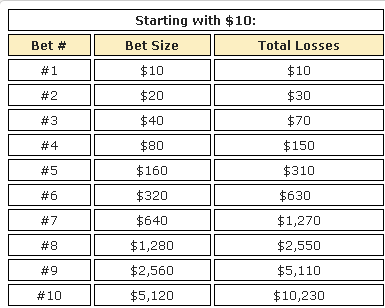
The Martingale System is one of the oldest and most straightforward betting strategies in casino gaming. While originally created for even-money games like Roulette, it is widely applied at the Baccarat table due to the near-50/50 odds offered by the Banker and Player bets.
What Is the Martingale Strategy in Baccarat?
How the Martingale System Works
The Martingale strategy is a negative progression system, meaning you increase your wager after every loss. The core mechanics are simple:
- Double your bet following a loss.
- Maintain your base unit size after a win.
The underlying premise is that a win is mathematically inevitable over a long enough timeline. When that win eventually occurs, it recovers all cumulative losses from the sequence plus a net profit equal to your initial base bet.
Why It’s Popular Among Baccarat Players
- Near-Even Odds: The Player bet carries a 48.76% win probability (excluding ties), while the Banker bet carries a 50.68% win probability (excluding ties).
- Low House Edge: Baccarat offers some of the lowest house margins in the casino (1.06% on Banker, 1.24% on Player), making it an ideal environment for progression systems.
How to Use the Martingale Strategy
Step-by-Step Betting Process
- Establish a Base Unit: Pick a base stake relative to your total bankroll (typically 1% or less).
- Select One Outcome: Stick consistently to either Banker or Player for the entire sequence.
- Double Upon Loss: If your hand loses, double your stake on the subsequent round.
- Reset Upon Win: Once a hand wins, collect your profits and reset your stake back to your initial base unit.
Example of a Martingale Betting Sequence
Assuming a $10 Base Unit placed exclusively on the Player bet (payout 1:1):
| Round | Bet Amount | Hand Outcome | Round Profit/Loss | Cumulative Net Profit/Loss |
| Round 1 | $10 | Loss | -$10 | -$10 |
| Round 2 | $20 | Loss | -$20 | -$30 |
| Round 3 | $40 | Loss | -$40 | -$70 |
| Round 4 | $80 | Loss | -$80 | -$150 |
| Round 5 | $160 | Win | +$160 | +$10 |
| Round 6 | $10 (Reset) | Win | +$10 | +$20 |
Notice how Round 5 instantly erases the -$150 accumulated loss across Rounds 1–4, returning a +$10 net gain equal to the starting base unit.
Advantages of the Martingale Strategy
Simple and Easy to Follow
Unlike complex card-counting methods or non-linear mathematical formulas, the Martingale requires no dynamic calculations or visual pattern tracking at the table.
Potential to Recover Previous Losses
In the short term, a single winning hand erases a long losing streak. For players seeking short-term wins during brief sessions, the strategy boasts a high statistical success rate per session.
Risks of the Martingale Strategy
Rapidly Increasing Bet Sizes
Exponential growth is the greatest danger of the Martingale. Wagers escalate at a staggering rate during an extended losing streak:
(Where $n$ is the number of consecutive losses).
Base Unit ($10)
 ├── Loss 1: $10
 ├── Loss 2: $20
 ├── Loss 3: $40
 ├── Loss 4: $80
 ├── Loss 5: $160
 ├── Loss 6: $320
 ├── Loss 7: $640
 └── Loss 8: $1,280 (Total Risk: $2,550 to win $10)
Table Limits and Bankroll Constraints
- Max Table Limits: Casinos cap maximum wagers specifically to neutralize progression systems. If a table ranges from $10 to $500, you cannot place the required 6th consecutive double ($320 → $640).
- Bankroll Depletion: A run of 7 to 10 consecutive losses is far more common over thousands of shoes than most players anticipate.
Is the Martingale Strategy Effective?
When It May Work
The system can work well during short sessions with a strong bankroll, provided you set strict profit targets and stop-loss limits.
Its Long-Term Limitations
The Martingale does not alter the fundamental house edge.
- The Banker bet retains its 1.06% house margin over time.
- Furthermore, the 5% commission charged on winning Banker hands slightly erases the full net recovery on a win, meaning a winning hand at $160 returns $152 net (leaving a minor deficit if factoring prior losses).
Alternatives to the Martingale Strategy
  Betting Systems Comparison
         │
         ├── Reverse Martingale (Positive Progression: Double after WINS)
         ├── Fibonacci System (Slower Escalation: 1, 1, 2, 3, 5, 8...)
         └── Flat Betting (Fixed Risk: Same stake every round)
Reverse Martingale (Paroli)
Instead of doubling after losses, you double your stake after wins. This lets you capitalize on hot streaks while capping consecutive loss exposure strictly to your original base unit.
Flat Betting
Wagering the exact same amount on every single hand. While less dramatic, flat betting protects your bankroll from exponential decay and preserves playtime over extended shoes.
Fibonacci System
A positive/negative hybrid based on the Fibonacci numerical sequence ($1, 1, 2, 3, 5, 8, 13\dots$). You step up one number in the sequence following a loss and move back two steps after a win, escalating far slower than standard Martingale doubling.
Tips for Using the Martingale Strategy
Set a Budget
Determine your maximum loss limit before sitting down. Decide in advance how many consecutive doubles your bankroll can sustain (e.g., stopping strictly after 5 consecutive losses).
Know When to Stop
Set a profit goal (such as winning 5 to 10 base units) and walk away once achieved. Prolonged play guarantees that long-tail losing streaks will eventually trigger.
Choose Low House Edge Bets
Always place Martingale progressions on Banker or Player wagers. Never apply progression doubling to high house edge options like Tie (14.36% edge) or Pairs (10.36% edge).
While the Martingale strategy can generate consistent short-term wins, it is not a foolproof path to long-term profitability. Its steep exponential growth requires an unlimited bankroll and no table limits to work perfectly. By pairing the system with strict stop-losses, disciplined bankroll sizing, and low house-edge bets, you can minimize exposure while managing session volatility.